> For the complete documentation index, see [llms.txt](https://doc.engenius.ai/llms.txt). Markdown versions of documentation pages are available by appending `.md` to page URLs; this page is available as [Markdown](https://doc.engenius.ai/home-engenius-qsg-library/engenius-cloud-qsg/cloud-access-point/ecw560.md).
# ECW560
Cloud Managed Wi-Fi 7 2×2 Outdoor Access Point (ECW560)
## Introduction
This Quick Start Guide is designed to guide you through the installation of the **Cloud7 2x2 Outdoor** Access Point, model **ECW560**, including hardware mounting and configuration.
{% hint style="info" %}
## Cloud7 2x2 Outdoor
### Cloud Managed Wi-Fi 7 2×2 Outdoor Access Point
#### **Model: ECW560**
* Wi-Fi 7 technology for high-performance Wi-Fi in high-density, multi-device environments.
* Two spatial streams support up to 2,900 Mbps (5GHz) & 700 Mbps (2.4GHz).
* Four (4) (2x2) detachable 5dBi high-gain, 360° SMA-type antennas.
{% endhint %}
Content Quick Links
* [**Hardware Overview**](#hardware-overview)
* [**Hardware Mounting**](#hardware-mounting)
* [**Configure with EnGenius Cloud**](#configure-with-engenius-cloud)
## Package Contents
## System Requirements
The EnGenius Cloud is primarily accessible with a web browser or mobile app. Before signing up for the EnGenius Cloud Service or logging on to the EnGenius Cloud Platform to manage your network, ensure that you've downloaded the right app and used the supported browser.
### **Mobile App:**
**EnGenius Cloud To-Go** (iOS/ Android supported)
:arrow\_down: [Download the Cloud To-Go mobile app here](https://qr.engenius.ai/app/cloud2go)

### **Web Browser:**
* Google Chrome (57.0.2987.110 and later)
* Microsoft Edge (80.0.361.103 and later)
* Mozilla Firefox (52.0 and later)
## **Network Requirements**
Before you get started, please make sure your network environment is DHCP-enabled. EnGenius Cloud Access Points (ECW series) are default assigned an IP address dynamically by the DHCP server.
{% hint style="info" %}
If you encounter issues with IP address assignment, you may want to change your IP assignment from "**DHCP mode**" to "**Static IP**". Please check the "[User Manual: Login to Local Access Page](https://docs.engenius.ai/engenius-cloud/getting-started/device-setup/troubleshooting-ecw-ap/login-to-local-access-page)" for more details.
{% endhint %}
## Hardware Overview
### Ports

### LEDs
## Hardware Mounting
The ECW560 can be mounted on the **Wall** and **Pole**, and please perform the steps for the appropriate installation:
### Wall Mount
1. Determine where the **Access Point** to be placed and mark location on the surface for the four mounting holes. Use the appropriate drill bit to drill four 8.1mm diagram and 26mm depth holes in the markings.
2. Screw the **Anchors** into the holes until they are flush with the wall.
3. Fasten the **Mounting Bracket** with the included **Screws** into the **Anchors**
4. Hang the **Access Point** against wall onto the **Mounting Bracket**.
5. Secure the **Access Point** on the **Mounting Bracket** with the secure lock on the side.
### Pole Mount
1. Thread the open end of the Pole Mounting Strap through the two tabs on the Mount Bracket.
2. Lock and tighten the **Pole Mounting Strap** to secure the **Mount Bracket** to the pole.
3. Hang the **Access Point** onto the **Mounting Bracket**.
4. Secure the **Access Point** on the **Mounting Bracket** with the secure lock on the side.
### Power in
A) Loosen the two screws on the bottom cap of the enclosure, remove the bottom cap off of the enclosure.
B) Remove the cable grommet and grommet plug from the passthrough-hole second from the right.
(C) Thread the Ethernet cable through the passthrough-hole and plug it into the PoE port, then slide the grommet onto the cable and insert it back into the pass-through hole. Finally, check that the grommet is securely seated and properly sealed, ensuring there are no gaps.
Note: Avoid pulling the Ethernet cable too tightly, as this can create strain and impact data performance. Conversely, leaving excessive slack may obstruct the proper installation of the top cover.
Use a Cat5e or Cat6 Ethernet cable with a 5.5\~6.5mm diameter
Note: Please note that the Ethernet cable should be a Cat5e or Cat6 with a 5.5\~6.5mm diameter and the type of network connector.
D) Put the bottom cap back onto the enclosure, tighten the two screws on the bottom cap of the enclosure.
## **Configure with EnGenius Cloud**
### **Step1: Register Device and Assign to Network**
You can register the device either by **Cloud To-Go** **mobile app** or the **EnGenius Cloud platform**.
#### **Cloud To-Go Mobile App**
1. Open and log in to the **EnGenius Cloud To-Go** mobile app.
2. Scan the QR code on the back of the device via the app.

3\. If the camera successfully scans a QR code, the app will display the device Information. You could tap "**Register**" to complete the Registration.

4\. Registered devices will be shown on the ***Inventory\&License*** page. Slide left the device and click "**Add to Network**" add the device to your personalized Network.
{% hint style="info" %} **Network**: Management domain shared same configurations within EnGenius Cloud**.**
{% endhint %}

#### **EnGenius Cloud Platform**
1. Log in to the **EnGenius Cloud Platform**: .
2. Go to the ***home > Inventory\&License*** page and click "**Register Device**".
3. Enter the **Serial Number** of the device(s) for device registration. Please refer to "[User Manual-Registering Devices to Organization](https://doc.engenius.ai/home-cloud-user-manual/getting-started/device-setup)".

4\. Select the registered device and click "**Assign to Network**" to add the device to your personalized Network.
{% hint style="info" %} **Network**: Management domain shared same configurations within EnGenius Cloud**.**
{% endhint %}

### **Step2: Power On Device**
The EnGenius Cloud AP devices can be powered by any of the following:
* EnGenius Cloud PoE Switch or 802.3at PoE+ compliant Switch
* EnGenius PoE Adapter (EPA5060XBT)
{% hint style="danger" %}
Do not use both power sources at the same time.
{% endhint %}
#### Connecting to a PoE Switch
Connect the Ethernet cable from the EnGenius Cloud AP directly to the PoE port of the PoE switch.

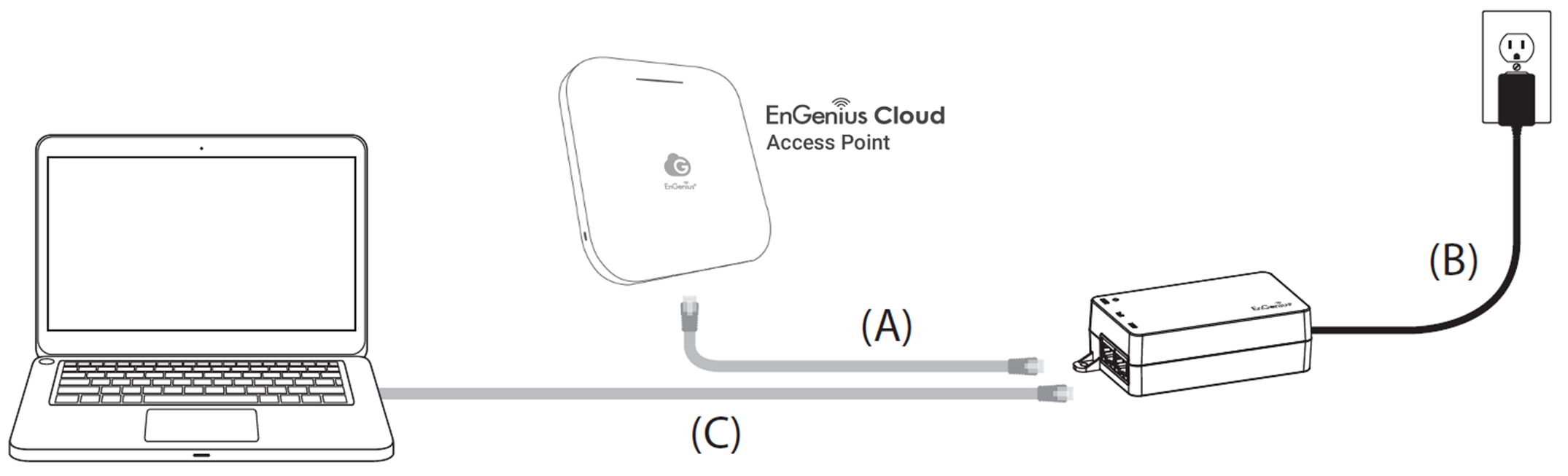
#### **Powered with a PoE Adapter**
(A) Connect one end of the Ethernet cable into the LAN (PoE) port of EnGenius AP and the other end to the PoE port on the PoE Adapter.
(B) Connect the power cord with the PoE Adapter and plug the other end into an electrical outlet.
(C) Connect the second Ethernet cable into the LAN port of the PoE Adapter and the other end to the Ethernet port on the computer.
{% hint style="info" %}
Please ensure to use cat5/cat5e UTP/STP RJ45 Ethernet cables.
{% endhint %}
### Step3: Connect to the EnGenius Cloud
Once the device is powered on and ready to connect to the Internet, the **LED indicator** will stay *Solid On*, which means the device is now connected to the EnGenius Cloud Platform. It will automatically download the default configuration settings from EnGenius Cloud for automated provisioning.
{% hint style="warning" %}
When the Access Point is connected to the EnGenius Cloud Platform for the first time, it will automatically check the latest firmware version available. If the **firmware upgrade** is required, it might take **8\~10 minutes** to complete the process. The **LED** indicator will be *Flashing (0.5 sec)* till the process is finished.
{% endhint %}
### **Step4: Manage with the EnGenius Cloud**
Log in to the [**EnGenius Cloud**](https://cloud.engenius.ai/) **platform** to configure detailed settings. For more information, please refer to [User Manual](https://docs.engenius.ai/engenius-cloud/).

## Troubleshooting
If your AP cannot be managed by the EnGenius Cloud Platform, there might be a problem with connecting to EnGenius Cloud.
To troubleshoot the connection issue, you may log in to the **Device Local Access** page:
1. Use your client device (e.g., a laptop, mobile device, or tablet) to find the SSID: "**EnMGMTxxxx**" (xxxx is the last four digits of MAC - MAC would be found on the back of the device) and connect to it.
2. Under your web browser, enter the URL: [**http://EnGenius.local**](http://engenius.local/) or **** to access the device's user interface.
3. You can review the device status after logging into the AP with the default admin account/password (admin/admin).
4. Check the information on **Network Connectivity** and take action if necessary.

{% hint style="info" %} **Change IP Assignment Settings**
By default, the EnGenius Cloud Access Point (ECW series) is assigned an IP address dynamically by the DHCP server. If you encounter issues with IP address assignment, please double-check the IP setting, including IP address, subnet mask, gateway, proxy, and management VLAN. If the issue still exists, you may change your IP assignment from "***DHCP mode***" to "***Static IP***" via the following procedure.
1. Go to the **Local Setting** section.
2. Change IPv4 settings to "***Use Static IP***".
3. Configure the ***IP address, gateway, subnet mask, and proxy*** settings.
4. Reconnect this device to the LAN network and try again.

{% endhint %}
For more details, please refer to the "[User Manual-Troubleshooting ECW AP](https://docs.engenius.ai/engenius-cloud/getting-started/device-setup/troubleshooting-ecw-ap)".
##
---
# Agent Instructions
This documentation is published with GitBook. GitBook is the documentation platform designed so that both humans and AI agents can read, navigate, and reason over technical content effectively. Learn more at gitbook.com.
## Querying This Documentation
If you need additional information that is not directly available in this page, you can query the documentation by asking a question.
Perform an HTTP GET request on the following URL with the `ask` and `goal` query parameters:
```
GET https://doc.engenius.ai/home-engenius-qsg-library/engenius-cloud-qsg/cloud-access-point/ecw560.md?ask=&goal=
```
`ask` is the immediate question: it should be specific, self-contained, and written in natural language.
`goal` is what the user is ultimately trying to achieve, the reason they need the answer. Sharing it helps GitBook give you a better, more relevant answer. A goal is most helpful when it describes the outcome the user wants rather than restating the question. For example, with `ask=how do I create an API token`, a goal like `automate deployments from our CI pipeline` lets GitBook tailor the answer to that use case.
The response will contain a direct answer to the question and relevant excerpts and sources from the documentation.
Use this mechanism when the answer is not explicitly present in the current page, you need clarification or additional context, or you want to retrieve related documentation sections.
.png?alt=media&token=c1f0aa7b-4987-4454-b1ce-24d3602f02aa)


.png?alt=media&token=17c1ab9a-0811-41f4-b765-01f75f3173d8)
.png?alt=media&token=695d49e4-70a5-47e3-9c16-427695ad9981)
.png?alt=media&token=90e56b1a-8e7a-4533-8cf3-50022a443cdf)

.png?alt=media&token=fb5fae0c-ced2-4325-a500-583fd109c230)


.png?alt=media&token=1da55880-44b2-4876-a9e6-aa07f9b72ab6)
.png?alt=media&token=429fae8a-59bf-4327-83a3-6ee09ba12654)